%20with%20glow%20(t.png)
Resources
See below to download game rules in other languages, see the complete Card Reference Guide,
and learn about basic baseball scoring rules and terminology to further enhance gameplay!

Card Reference Guide
Each card in Take the Field represents a baseball event and appears in the deck in approximate proportion to how often that event occurs in real games. Cards include brief instructions, and this guide provides additional clarification and baseball context when needed.
Blue-themed cards indicate plays where no out is recorded, while red-themed cards indicate that at least one out occurs.
To streamline gameplay, Take the Field simplifies real-world variability by assigning consistent, common outcomes to each event. Baserunner instructions only apply when runners are already on base when the card is scored at the end of the inning.
ALPHABETICAL ORDER (# OF CARDS IN DECK):
.png)
Double – Down the Line (2)
The batter hits the ball sharply along the first or third base line - just fair - and the batter hustles to second base. All runners advance two bases. These plays often result in the ball ending up deep into the corner of the outfield, giving runners extra time to advance further before the ball is returned to the infield.
.png)
Double – In the Gap (1)
The batter hits the ball into the gap between two outfielders - either in left-center or right-center field - and reaches second base. All runners score. In a baseball game, these hits frequently roll to the wall and are among the most productive hits for clearing the bases.

Error (1)
The batter hits the ball in a way that should have resulted in an out, but a defensive misplay allows them to reach first base safely. All baserunners advance one base. While errors in baseball can lead to chaotic and wide-ranging results, this card reflects the more typical and conservative outcome.
.png)
Fly Out – Sacrifice Fly (5)
The batter hits a fly ball deep into the outfield that is caught before it touches the ground, so the batter is out. After the catch, runners on second or third base can usually “tag up” and advance one base. Runners on first base typically hold, as the throw to second is easier and riskier to challenge. Since the batter is out but helps move runners forward, it’s considered a productive out - known as a “sacrifice fly.”
.png)
Fly Out – Shallow (12)
The batter hits a shallow fly ball that is caught before it touches the ground, so the batter is out. All runners remain on their current bases. In baseball, runners must “tag up” after a catch before they can try to advance - but on shallow fly balls, the risk of being thrown out is too high. These catches happen either in the infield or in the closer part of the outfield, making it easy for defenders to prevent advances.
.png)
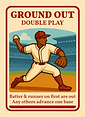
Ground Out – Double Play (20)
The batter hits a ground ball to an infielder. If there are no runners on base, this simply results in one out. But if there’s a runner on first, the defense turns a double play - getting the runner out at second base, then the batter out at first. While baseball offers a variety of possible outcomes when more runners are on base, Take the Field keeps it simple: any runners on second or third advance one base.
.png)
Ground Out – Sacrifice Bunt (1)
The batter gently taps the ball into play - called a bunt - intending to advance the baserunners. All runners advance one base, while the batter is out at first. In baseball, this is a classic example of a “sacrifice play.” If there are no runners on base, this card acts as a standard ground out.
.png)
Ground Rule Double (1)
The batter hits a fair ball that bounces out of play - typically over the outfield fence or into the stands along the foul lines. This results in a ground rule double. The batter is awarded second base, and all runners automatically advance two bases. Because the ball is out of play, the defense has no opportunity to make a play, and runners are limited to two bases, even if they might have been able to advance further.

Hit By Pitch (1)
The batter is struck by a pitch during their at-bat and is immediately awarded first base. Any baserunners advance only if forced. The outcome is functionally identical to a walk.

Home Run (4)
Typically, a home run occurs when the batter hits the ball over the outfield fence in fair territory without it touching the ground. It’s unplayable, so the batter and all baserunners score. Home runs are among the most celebrated moments in baseball and can quickly change the momentum of a game. Additionally, an inside-the-park home run is a rare and exciting play that occurs when the ball stays in play but the batter races around all the bases prior to the ball being returned to the infield to tag them out.

Instant Replay (4)
In broadcast baseball, an “instant replay” is used to let fans re-watch a key play. For the purposes of Take the Field, that concept has been reimagined more literally: the event shown on the previous card occurs again! Though not a direct simulation of how replay is used in baseball, this card adds a layer of excitement and unpredictability to the inning’s story. An Instant Replay card duplicates the effect of the card immediately to its left in the sequence. It does not repeat any earlier events or outcomes - only the single card beside it.
For example, the sequence: Walk, Home Run, Instant Replay results in three runs. The Home Run scores two runs (the batter and the runner from first), and the Instant Replay acts as another Home Run, adding one more run. Two of these in a row repeat the event again.
.png)
Line Out – Double Play (4)
The batter hits a hard line drive that is caught by a fielder. If there are no runners on base, this results in a single out. But when runners are on base, it’s a prime opportunity for the defense to turn a double play. If a runner strays too far off base expecting the ball to drop, they may be thrown out before returning. For simplicity in Take the Field, when at least one runner is on base, both the batter and the lead runner are out. These quick plays often catch aggressive base runners off guard.
.png)
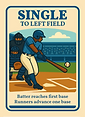
Single – To Left Field (5)
The batter hits the ball past the infield into left field and reaches first base safely. All baserunners advance one base. While runners in a baseball game sometimes attempt to take extra bases, the left fielder’s proximity to third base often limits advancement—so Take the Field keeps it simple with a one-base advance for all runners.
.png)
Single – To Right Field (5)
The batter reaches first base safely with a hit into right field. All runners advance two bases. Right field singles more frequently result in longer baserunner advancement since the throw to third base is longer, giving runners more time to advance.
.png)
Single – Up the Middle (5)
The batter hits the ball safely into center field. All runners advance two bases. In baseball, center fielders typically cover more ground than other outfielders, and the extra time it takes to retrieve the ball often allows baserunners to stretch their advance.
.png)
Strikeout – Looking (8)
The batter does not swing but the umpire rules the pitch to be strike three. The batter is out, and no runners advance. “Looking” strikeouts can be controversial depending on how close the pitch was.
.png)
Strikeout – Swinging (15)
The batter swings and misses on strike three. The batter is out, and no runners advance. This is the most common type of strikeout and reflects a failed attempt to make contact.

Triple (1)
The batter hits the ball deep into the outfield and reaches third base safely. All runners score. A triple is one of the rarest and most exciting plays in baseball, typically requiring a well-placed hit and fast base running.

Triple Play (1)
Three outs are recorded on one continuous defensive sequence. In baseball, this ends the inning immediately. Triple plays are extremely rare but thrilling when they happen, often requiring a perfect combination of quick reflexes and coordination. In Take the Field, this card counts as a single out if no runners are on base, two outs if there is one baserunner, and three outs if there are two or more baserunners when it is scored as part of the player’s sequence of cards at the end of an inning.

Umpire Review (4)
In baseball, an umpire review occurs when the validity of a call is challenged—often using video replay. This can include determining whether a ball was fair or foul, if a tag was made in time, or if a batter was safe or out. Reviews are a modern part of the game that adds suspense and accountability to key moments. In baseball, umpire reviews can result in the original call standing, or having the original call overturned. For added excitement in Take the Field, all umpire reviews result in the call being overturned. Two Umpire Review cards side by side cancel each other out, and the card to their left is counted as normal. Three in a row behave like one. Four act like two.

Walk (8)
The batter is awarded first base after receiving four pitches outside the strike zone. Only forced runners advance. For example, a runner on first base moves to second to make room for the batter at first. However, runners on second or third do not advance unless they are forced to by runners behind them.

Pre-Game Warmup
BASEBALL BASICS: A QUICK OVERVIEW
If you’re new to baseball, this section offers a quick overview of how the sport works. While many rules and nuances are left out, this will give you a foundation for understanding the events represented on the cards in Take the Field and how scoring works in the game.
-
Innings: A baseball game is played in innings. During each inning, one team bats while the other plays defense. Once the batting team accumulates three “outs”, their half of the inning ends and the other team bats. In Take the Field, however, all players are always batting - there is no defensive role. Each player builds their own inning by drawing and playing cards to score runs, and their inning (or round) ends when they accumulate three outs. A full game is nine innings.
-
At-Bats: In a game of baseball, batters face pitches from a pitcher during an “at-bat.” A pitch within the strike zone that the batter misses or doesn’t swing at is called a “strike.” A pitch outside the strike zone that the batter doesn’t swing at is called a “ball.”
-
Three strikes = Strikeout (batter is out)
-
Four balls = Walk (batter goes to first base)
-
-
Outs: In addition to a strikeout, an out can occur in several ways - such as when a fielder catches a hit ball before it touches the ground, throws the ball to a base a runner is forced to advance to, tags a runner between bases, or catches a runner off base after a fly ball is caught.
-
Runs: In baseball, points scored by teams are called “runs.” Batters take turns one at a time, trying to get on base. This can be done by hitting the ball, drawing a walk, or being hit by a pitch. Once on base, they become “baserunners” or “runners” and aim to advance around the bases (counter-clockwise) and eventually score by reaching home plate. Runners move forward with the help of their teammates’ hits or other plays. Each base is a safe zone - runners can’t be tagged out while standing on a base, but if they step off or are caught between bases during a play, they risk being tagged out. Only one runner is allowed on each base at a time.
-
Fair vs. Foul: A hit ball is a “fair” ball if it lands between the first and third base lines. A ball hit outside this area is a “foul” ball and the batter continues the at-bat unless it is caught before touching the ground.
-
Field of Play: The field is divided into the infield (defended by six players: pitcher, catcher, first baseman, second baseman, shortstop, third baseman) and the outfield (defended by three players: left fielder, center fielder, and right fielder). In general, balls hit to the infield often result in outs (unless an error is made or the batter is especially fast), while balls hit to the outfield often result in players reaching base safely unless the ball is caught before touching the ground.
Take the Field simulates this environment and process. The sequence of your cards forms the story of your team’s inning. Cards can represent hits, outs, baserunning events, and more. Score as many runs as you can before your third out ends the inning!